

Wiki / Instruments / Setar
History
The setar is an Iranian instrument, smaller than the tar, with a pear-shaped end. It began with three strings and became a four-string instrument about 150 years ago. It used to belong with the tar and the tanbur. Today its shape, technique, and the way it is played put it close to the tar. The draft says traces of a similar instrument have been found among the antiquities of Susa, about two thousand years old, and that the oldest setar it can name belongs to the reign of Naser al-Din Shah Qajar. In that account the shah gives his setar away. The new owner’s son later takes up the instrument with Mirza Abdollah. The sound of setar playing reaches the owner by radio, and Naser al-Din Shah’s setar is in the end given to Ahmad Ebadi, Mirza Abdollah’s son.
About two and a half centuries ago — the draft gives both this span and the “about 150 years” above — Moshtaq Ali Shah changed the setar from three strings to four, to strengthen the sound and to make more complicated tones possible. The draft says the sound drew specialists and mystics, and that the instrument can carry heavy, complicated music. Ahmad Ebadi was the first to play setar solo on the radio. To bring listeners to that sound he set it with santur and tar.
Parts
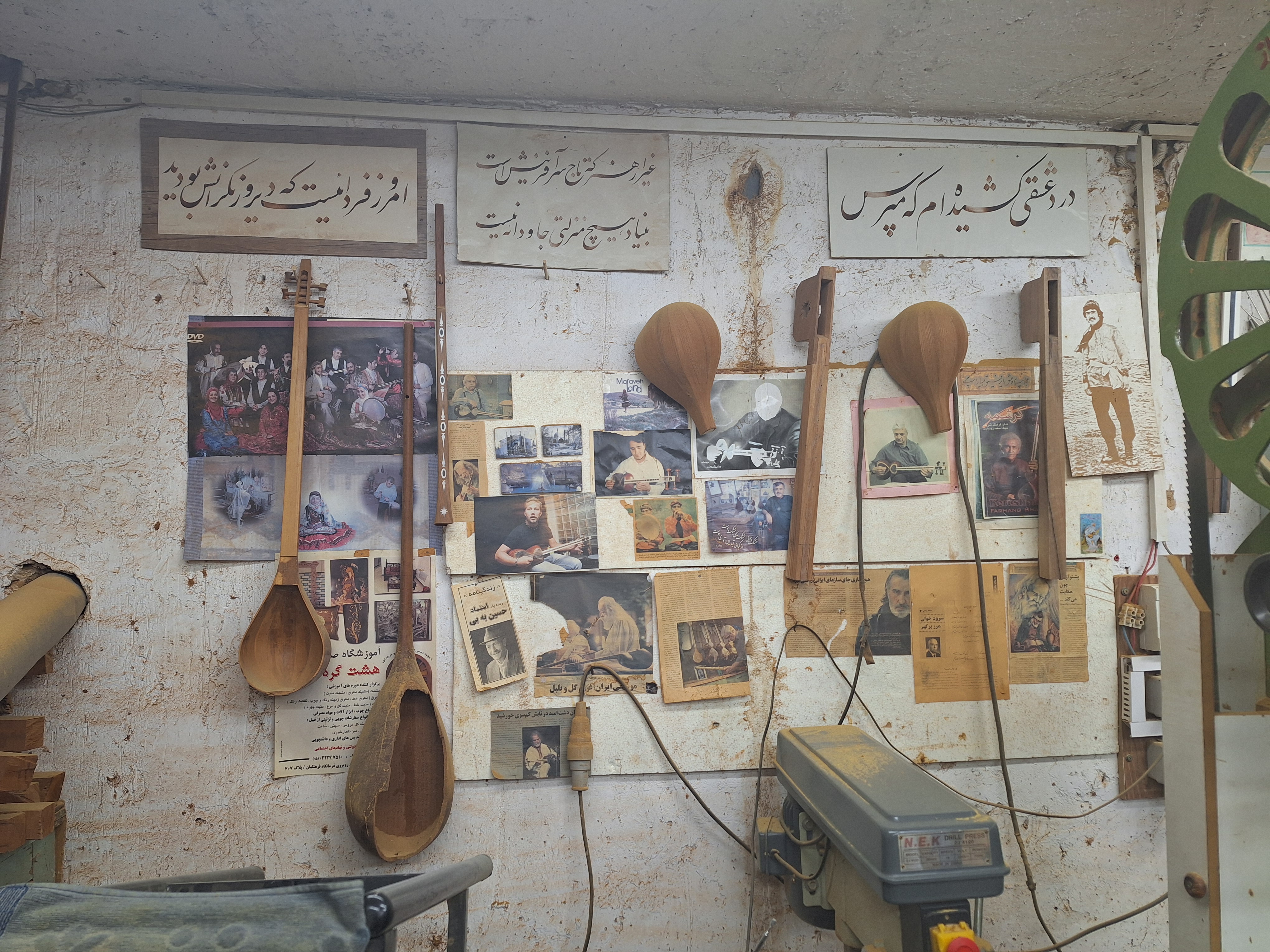
Bowl. The soundbox is made of mulberry, and sometimes of walnut. The wood may be laminated or a single piece. The neck is generally walnut. Shell or bone is sometimes set into it for appearance. The bowl resembles the oud and the tanbur, and it is smaller.
Soundboard. A wooden face with holes so the sound can leave the bowl.
Neck. The frets are tied on it, and it is narrower than the bowl: about 25 millimeters across and 40 to 50 centimeters long. It is a solid piece, half-round underneath and flat on top. One end joins the bowl and the other the pegbox.
Frets. There are 26, and one of them is tied before the nut. The strands were gut or silk, wound in threes and fours across the neck to mark the intervals. Today they are nylon, so the hand moves more easily and left-hand ornaments are easier.
Nut. It sits between the neck and the pegbox and is bone or plastic. It guides and spaces the strings at the top of the neck.
Pegbox. Wood, at the start of the neck, with four pegs, two on each side. Sometimes the inside is hollowed outward and the strings are tied as on the tar. Sometimes the pegbox continues the line of the neck, and the strings leave it outward onto the pegs.
Tailpiece. Wood, sometimes bone, fixed at the end of the bowl. The strings are knotted into a groove on it.
Strings. Four metal strings of different thicknesses. Moshtaq Ali Shah added the fourth, and some people call it the Moshtaq string. The third and fourth sit close together and are played at the same time as the bass pair. The first and third are a similar diameter, steel, and white. The second and fourth are bronze. The fourth is the thickest.
Pegs. Each string runs from the tailpiece to a tuning peg. Turning the pegs tunes the setar.
Character
Beside other instruments the setar is quiet, fine, penetrating, and pleasing. It has no separate plectrum. It is played with the nail of the index finger, which the draft says makes the playing feel more intimate, and the small body is held against the player. Because the nail usually meets more than one string, different sounds and tunings are possible. It has four strings and no skin, so the sound is plain and penetrating and it needs less retuning while playing. The draft says it has a particular beauty inside a group.
Players named in the Persian draft: Mirza Abdollah Farahani, Arsalan Dargahi, Darvish Khan, Abolhassan Saba, Nur Ali Borumand, Jalal Zolfonun, Mohammad Reza Lotfi, Yusef Forutan, Saeed Hormozi, Dariush Safvat, Parviz Meshkatian, Ali Akbar Khan Shahnazi, Hassan Kassai.
Contemporary names in the draft: Dariush Talai, Dariush Pirniakan, Majid Derakhshani, Hamid Motebassem, Masoud Shaari, Kayhan Kalhor, Keyvan Saket, Hossein Alizadeh, Ghashang Azad, Davud Azad, Behdad Babaei.
Makers named in the draft: Abbas Mafakheri, Mohammadi, Ramin Jazayeri, Qavami.
Hossein Alizadeh is the musician record on this site. The other names stay inside this entry until a biography is on file for them.
Setar Artists
- Hossein Alizadehحسین علیزادهbiography placeholder